

Pass-through charging and uninterruptible power are not the same promise. A power bank that accepts incoming power while charging another device can simplify your charging routine, but that feature alone does not tell you what happens when wall power disappears. If your goal is to avoid a restart, the missing specification is often continuity—not battery capacity or headline wattage.
This guide explains how to compare pass-through charging vs UPS protection, where a laptop's own battery changes the decision, and what you should verify before relying on a USB power bank during an outage. It is a specification-based buying guide, not a transfer-time test of the iFORWAY 25,000mAh 170W Laptop Power Bank.
Start with two different questions
Pass-through charging asks: can the battery product receive power and supply a connected device under the manufacturer's stated conditions? Uninterruptible-power planning asks: will the entire load remain powered through an input failure, for the required duration, without an unacceptable interruption?
The first question is about a charging arrangement. The second is about behavior across an event. A product can document the first without documenting the second. That distinction matters when a USB accessory has no battery of its own, or when losing power even briefly would interrupt a session.
The iFORWAY 25,000mAh 170W Laptop Power Bank is a useful example. Current official product information lists pass-through charging, with a charger rated at 20W or higher and the condition that input power must exceed output power. Those conditions describe supported use; they are not a specification for seamless switchover. The official information reviewed for this guide does not establish a UPS mode or a guaranteed transfer time for the iFORWAY power bank.
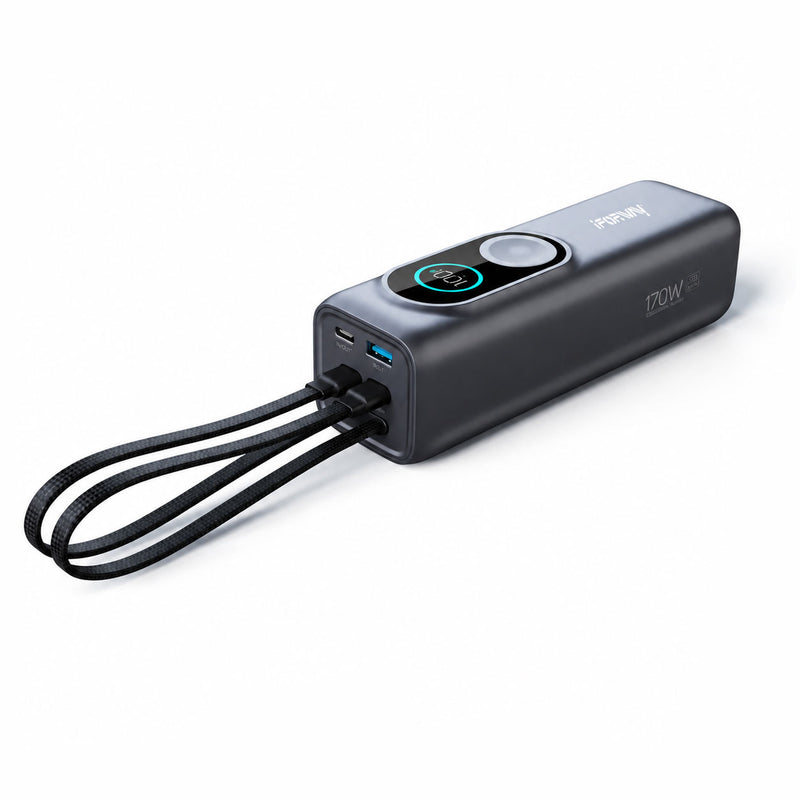
iFORWAY 25,000mAh 170W Laptop Power Bank
$129.69
High-capacity portable charging for laptops, phones, and more. Features up to 170W total output, dual built-in USB-C cables, Apple Watch wireless charging, and an easy-to-read display for power on the go.
Why transfer behavior matters more than the label
A UPS is chosen for a defined backup job. Even within that category, architecture affects the transition. Schneider Electric's transfer-time explanation distinguishes line-interactive units, which have a switching interval, from its listed double-conversion online units, which do not have that transfer interval during input loss. You should therefore check a particular product's documentation rather than assume every UPS behaves identically.
For a USB power bank, look for equally specific evidence: documented output behavior when input is removed, the supported operating mode, and any applicable transfer-time or continuity rating. “Pass-through supported” does not answer those questions. Nor does the absence of a published continuity rating prove that every connected device will restart. It means continuity is unverified and should not be promised.
Keep two columns in your notes: manufacturer-confirmed behavior and behavior you still need to verify. This prevents a useful charging feature from quietly becoming a much stronger backup claim.
A laptop and a batteryless accessory have different needs
A laptop has its own energy buffer
A laptop with a functioning, sufficiently charged internal battery can normally continue working when external charging stops. In that situation, the laptop battery—not an assumed power-bank UPS feature—is the buffer you are relying on. Its condition, charge level, workload and settings still matter.
Your planning question may simply be how to keep the laptop charged after the outage. That is a portable-energy task. Before choosing a bank for it, confirm the laptop accepts USB-C charging and compare its requirements with the bank's individual connection, using our laptop power bank wattage checklist.
A batteryless accessory depends on its external supply
A USB-powered accessory without an internal battery has no comparable stored-energy buffer. If continuity is essential, verify the accessory's power requirements and the backup product's transition behavior together. A plug that fits is not a continuity specification.
Also map dependencies. Keeping a laptop on does not automatically keep a separately powered display, storage accessory or network connection working. A communication session depends on more than the laptop's charging icon. Do not infer that the iFORWAY power bank can power a particular router, adapter or peripheral without official compatibility information for the complete setup.

A built-in device battery and a documented backup-power transition solve different problems. This conceptual diagram is not a wiring schematic for the iFORWAY 25,000mAh 170W Laptop Power Bank.
What the iFORWAY power bank's ratings establish—and what they do not
The iFORWAY 25,000mAh 170W Laptop Power Bank has a rated energy of 90Wh. Its maximum total output is 170W in specified connection combinations, while an individual USB-C charging connection is rated up to 100W. Those figures help you evaluate stored energy and charging demand. They do not describe an interruption interval or certify uninterrupted operation.
Capacity and continuity are independent checks. A larger energy rating cannot correct an undocumented transition. Likewise, a high output rating does not establish AC backup, surge protection or compatibility with every USB device. Choose a portable power bank for its documented charging functions rather than treating its wattage as proof of a different product category.
For pass-through use, the two official conditions for the iFORWAY power bank must be considered together. A 20W-or-higher charger is only the minimum charger requirement; it does not mean a 20W charger is sufficient for a high-demand connected load. Input power must also exceed output power. Charger capability, cable capability and the actual operating load all belong in that assessment.
For the ordinary desk workflow, see our pass-through charging desk checklist. This article answers the separate question of what you can conclude about backup continuity.
A five-question backup decision worksheet
-
What must remain on? List the exact device and any dependent equipment. Distinguish “charge later” from “must not restart now.”
-
Does it contain a usable battery? Check condition and charge before making that battery part of your plan.
-
What power input does it accept? Read the manufacturer's input specification. Do not substitute a connector's shape for a voltage, protocol or wattage requirement.
-
What transition behavior is documented? Ask the backup-product manufacturer about the relevant mode if the information is missing. An unknown answer remains unknown.
-
How much interruption and operating time can the task tolerate? Saving a document and maintaining a continuously operating accessory are different requirements. Select equipment against the actual task.
This worksheet is useful before buying, not just after connecting equipment. If uninterrupted operation is essential and the supplier cannot document the required behavior, choose equipment with an appropriate published backup specification instead of relying on a pass-through label.
How to check a non-critical setup responsibly
A small observation can reveal a problem, but it cannot create a manufacturer guarantee. Start with a non-critical device, save your work, follow both products' instructions and use compatible charging equipment. For pass-through use with the iFORWAY power bank, meet the stated charger and input-versus-output conditions first.
If the instructions permit checking behavior when the input charger is disconnected, observe whether the device remains on, whether its charging indicator changes and whether an accessory reconnects. Note the connected load and battery state. Do not open equipment, modify cables, defeat protections or use an unsuitable adapter to manufacture a backup arrangement.
A device staying on once does not measure transfer time. Its own battery may have masked the transition, or its tolerance may differ from another device's. Repeat observations are still observations, not certification. Avoid using an unverified arrangement for safety-critical or medical loads; obtain equipment specified for the required application.
Frequently asked questions
Does pass-through charging mean a power bank is a UPS?
No. It establishes a supported charging arrangement under stated conditions, not automatically a documented uninterrupted-power function. Check the manufacturer's continuity specifications separately.
Is the iFORWAY 25,000mAh 170W Laptop Power Bank guaranteed to switch seamlessly when its charger loses power?
The official information reviewed for this guide does not establish that guarantee. We have not measured its transfer behavior and do not represent it as a UPS.
Can a laptop keep running if external charging stops?
A working, sufficiently charged laptop battery can normally sustain the laptop after external charging stops. That does not guarantee that separately powered accessories or your network connection continue operating.
Does a bigger power bank solve an interruption problem?
No. Stored energy affects energy planning; transition behavior affects continuity. Both must match your needs, and neither rating substitutes for the other.
What are the iFORWAY power bank's pass-through charging conditions?
Current official information specifies a charger rated at 20W or higher, with input power exceeding output power. Follow the current product instructions and do not assume every charger or load combination qualifies.
Choose the charging function you actually need
For a battery-equipped laptop, portable USB charging may be the right answer. For a task that cannot tolerate a restart, start with documented backup and transition requirements. Knowing the difference helps you buy the correct equipment without overstating what a charging feature does.
If your goal is portable laptop charging rather than a certified uninterrupted-power arrangement, view the iFORWAY 25,000mAh 170W Laptop Power Bank and its current product details. Match the specifications to your devices before purchasing.
0 comments