

A 25,000mAh power bank sounds like it should charge your iPhone 18 Pro several times. But how many full charges can you actually expect?
A 25,000mAh power bank with 90Wh rated energy could theoretically provide approximately 4–5 full charges for certain iPhone 18 Pro variants or around 3–4 for an iPhone 18 Pro Max. These are planning estimates based on assumed energy efficiency, not measured charging results.
Real-world performance can be lower depending on your iPhone model, battery condition, charging efficiency, temperature, and whether you use your phone while it charges.
Let's break down the numbers so you can decide whether a 25,000mAh power bank is worth carrying.
How Many iPhone 18 Pro Charges Can You Get From 25,000mAh?
The number of full charges depends on the iPhone's battery capacity and the amount of energy the power bank can deliver.
For example, Apple's European product information lists battery capacities of 4,056mAh for the iPhone 18 Pro and 5,391mAh for the iPhone 18 Pro Max in the listed regional configurations.
Other regional versions may have different capacities.
For this illustration, we'll use the iFORWAY 25,000mAh 170W Laptop Power Bank, which has 90Wh of rated battery energy.
The table below assumes 70%–85% of that stored energy is ultimately available for charging the phone's battery. This is an illustrative efficiency range, not a measured efficiency specification for iFORWAY.
| iPhone Model | Battery Capacity | Estimated Full Charges |
|---|---|---|
| iPhone 18 Pro (referenced EU variant) | 4,056mAh | Approximately 4.0–4.9 |
| iPhone 18 Pro Max (referenced EU variant) | 5,391mAh | Approximately 3.0–3.7 |
These estimates assume an illustrative 3.85V nominal phone-battery voltage to convert mAh into Wh.
The table is intended for battery planning, not as a promise of a specific number of recharges.
If you're using your phone for navigation, video recording, gaming, or hotspot sharing while charging, you may get fewer complete battery replenishments.
Why Doesn't 25,000mAh Mean Six Full iPhone Charges?
You might be tempted to divide the power bank's 25,000mAh capacity by your iPhone's battery capacity.
For a 4,056mAh phone battery:
25,000 ÷ 4,056 ≈ 6.16
That calculation suggests more than six charges.
Unfortunately, it isn't a reliable way to estimate actual charging performance.
Here's why.
1. Battery Capacity Is Measured at Different Voltages
The 25,000mAh figure describes the power bank's nominal cell capacity.
Your iPhone has its own battery voltage and charging circuitry.
Comparing mAh ratings directly across different battery systems can give a misleading result.
A better unit for comparing stored battery energy is the watt-hour (Wh).
2. Voltage Conversion Consumes Energy
When a power bank charges your iPhone through USB-C, its circuitry converts stored battery energy into an appropriate output.
Your iPhone also manages incoming energy to charge its internal battery.
These processes are not perfectly efficient.
Some energy becomes heat instead of stored battery charge.
3. Your iPhone Uses Power While Charging
If you check messages, record videos, use GPS, or stream music while charging, some of the incoming power is used immediately.
That energy doesn't all go into increasing the battery percentage.
4. Temperature and Charging Conditions Matter
Charging efficiency and speed can vary with temperature, battery level, and charging conditions.
This means two people using the same power bank may not get exactly the same number of full charges.
How to Calculate Power Bank Charges More Accurately
Instead of comparing mAh alone, use battery energy in watt-hours.
The basic formula is:
Estimated full charges = Power bank energy (Wh) × Assumed overall efficiency ÷ Phone battery energy (Wh)
Let's use the iFORWAY 25,000mAh 170W Laptop Power Bank as an example.
Its published rated energy is 90Wh.
Step 1: Estimate Usable Energy
Assume an illustrative overall energy efficiency of 80%.
90Wh × 0.80 = 72Wh
That gives us an estimated 72Wh of energy stored in the phone battery over repeated charging cycles.
This is not an iFORWAY laboratory measurement.
Step 2: Estimate the iPhone Battery Energy
For this calculation, use the referenced 4,056mAh iPhone 18 Pro variant.
Convert 4,056mAh into 4.056Ah.
Assuming an illustrative nominal voltage of 3.85V:
4.056Ah × 3.85V ≈ 15.62Wh
This estimated battery energy is based on an assumed voltage rather than an official Apple Wh rating.
Step 3: Calculate Full Charges
72Wh ÷ 15.62Wh ≈ 4.61
Under these assumptions, the power bank could theoretically replenish approximately 4.6 iPhone 18 Pro battery equivalents.
For the referenced iPhone 18 Pro Max variant:
5.391Ah × 3.85V ≈ 20.76Wh
72Wh ÷ 20.76Wh ≈ 3.47
That gives approximately 3.5 full battery equivalents.
The result is useful for planning, but actual charging performance may differ.
Does Fast Charging Reduce the Number of Full Charges?
Charging at higher power can change the efficiency of the overall charging process.
However, fast charging doesn't automatically mean dramatically fewer full charges.
The result depends on the power bank, phone, charging circuitry, temperature, cable, and active device use.
The iFORWAY 25,000mAh 170W Laptop Power Bank supports up to 100W output through a single USB-C charging connection.
That doesn't mean an iPhone 18 Pro draws 100W.
The phone and power source negotiate a suitable charging arrangement.
For everyday users, the more important questions are whether the connection supports the phone and whether the power bank has enough stored energy for the trip.
Is 25,000mAh Enough for a Three-Day Trip?
For many people, it can provide a useful backup energy reserve.
Imagine you're taking a three-day city trip.
You'll probably use your iPhone for:
-
Maps and navigation.
-
Photos and video recording.
-
Messaging and phone calls.
-
Restaurant reservations and travel information.
-
Music, entertainment, and mobile payments.
If you have access to hotel charging every night, you may not need a large power bank at all.
But if you'll spend most of the day away from an outlet, a 25,000mAh power bank gives you more charging flexibility.
The important distinction is between several full battery equivalents and several days of guaranteed runtime.
Actual battery consumption varies too much to promise a fixed number of travel days.
Is a 25,000mAh Power Bank Better Than a 10,000mAh One?
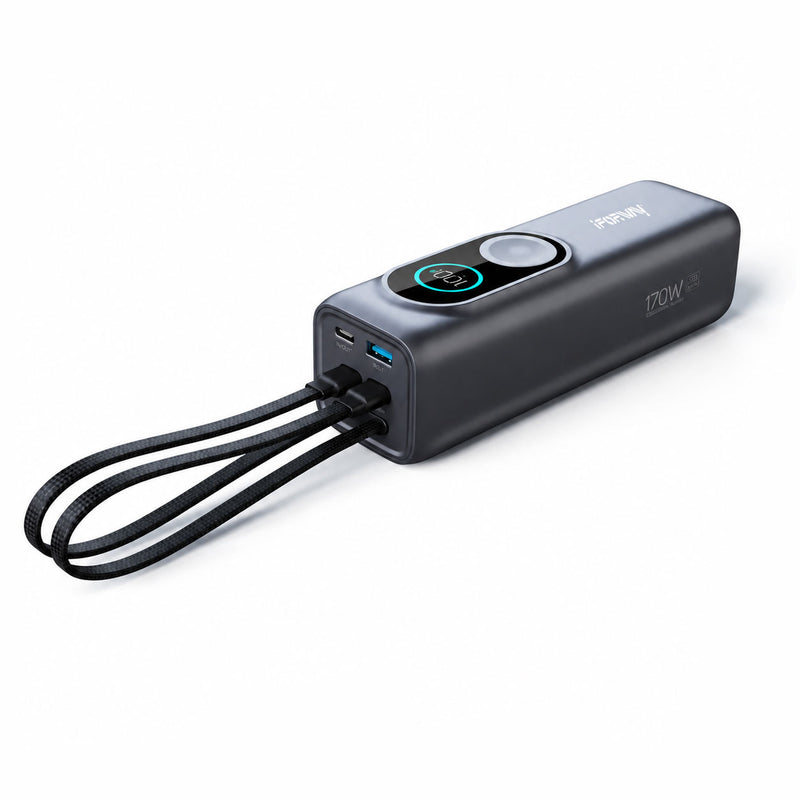
iFORWAY 25,000mAh 170W Laptop Power Bank
$129.69
High-capacity portable charging for laptops, phones, and more. Features up to 170W total output, dual built-in USB-C cables, Apple Watch wireless charging, and an easy-to-read display for power on the go.
Not necessarily.
A smaller power bank can be more convenient for people who only need occasional phone charging.
A larger one is more useful when you need a greater energy reserve or carry multiple devices.
| Feature | 10,000mAh Power Bank | 25,000mAh Power Bank |
|---|---|---|
| Nominal capacity | Lower | Higher |
| Typical size | Often smaller | Usually larger |
| Carrying convenience | Often pocket-friendly | More suitable for a bag |
| Available backup energy | Lower | Higher |
| Multiple-device flexibility | Model-dependent | Model-dependent |
| Laptop charging | Depends on output specifications | Depends on output specifications |
Capacity alone doesn't establish charging speed, laptop compatibility, or the number of ports.
You still need to compare the actual product specifications.
If you want a power bank primarily for short commutes and emergency phone charging, 10,000mAh may be enough.
If you're traveling with multiple devices, higher capacity becomes more attractive.
One Power Bank for Your iPhone, MacBook, and Apple Watch
Here's where a high-capacity power bank can offer more value than simply charging your iPhone several times.
The iFORWAY 25,000mAh 170W Laptop Power Bank is designed for multi-device charging.
Its features include:
| Specification | iFORWAY Power Bank |
|---|---|
| Battery capacity | 25,000mAh |
| Rated energy | 90Wh |
| Maximum total output | 170W |
| Single USB-C output | Up to 100W |
| Built-in USB-C cables | Two |
| Simultaneous charging | Up to five devices |
| Digital display | Yes |
| Compatible watch wireless charging | Up to 3W |
Rather than carrying separate portable batteries for your phone and laptop, you can use one high-capacity charging device when the connections and power requirements are compatible.
For example, during a long workday, you might charge your iPhone from one built-in USB-C cable while charging a compatible laptop from another connection.
Keep in mind that charging several devices draws from the same 90Wh battery reserve.
The more energy you use for your laptop or tablet, the less remains available for your iPhone.
Why Two Built-In USB-C Cables Are Useful
If you've ever arrived at the airport with a power bank but forgotten your charging cable, you already know why built-in cables matter.
The iFORWAY model includes two integrated USB-C cables.
This makes it easier to connect compatible devices without unpacking a separate cable every time.
For people who travel regularly, that small convenience can make a noticeable difference.
iFORWAY 25,000mAh 170W Laptop Power Bank
$129.69
High-capacity portable charging for laptops, phones, and more. Features up to 170W total output, dual built-in USB-C cables, Apple Watch wireless charging, and an easy-to-read display for power on the go.
Five Ways to Get More Useful Charging From Your Power Bank
You can't eliminate charging losses, but you can make more efficient use of the energy available.
1. Avoid Heavy Phone Use While Charging
Video recording, gaming, navigation, and mobile hotspot use all consume energy.
When possible, reduce demanding activities while recharging.
2. Use a Suitable USB-C Connection
Use a charging connection that meets your phone's supported requirements.
Higher advertised wattage doesn't guarantee faster phone charging if the relevant charging profiles aren't supported.
3. Keep Devices Away From Excessive Heat
Avoid leaving your phone and power bank in direct sunlight or inside a hot vehicle.
Higher temperatures can affect charging behavior.
4. Monitor Remaining Battery
A power bank with an integrated display can help you decide when to recharge it.
The iFORWAY model includes a digital display for battery and charging information.
5. Recharge the Power Bank Before Traveling
The iFORWAY power bank supports up to 100W input.
According to its published product information, under specified conditions using a 100W-or-higher charger at approximately 77°F (25°C), a full recharge typically takes around two hours.
Actual recharge time can vary with the charger, temperature, and charging conditions.
Can You Take a 25,000mAh Power Bank on a Plane?
Airline battery requirements are generally based on watt-hours.
The iFORWAY power bank has a rated energy capacity of 90Wh.
That is below the FAA's standard 100Wh limit for lithium-ion spare batteries carried by passengers.
Power banks belong in carry-on baggage, not checked baggage.
Individual airlines may have stricter rules concerning quantity, use, or charging during flights.
Before traveling, verify the current requirements of your airline.
Frequently Asked Questions
Can a 25,000mAh power bank charge an iPhone 18 Pro five times?
It may approach five full battery equivalents under favorable assumptions for some iPhone 18 Pro variants, but five full charges should not be treated as a guaranteed result. Actual performance depends on the phone model, efficiency, temperature, and device use.
How many times can 25,000mAh charge an iPhone 18 Pro Max?
Using a 90Wh power bank, the referenced 5,391mAh iPhone 18 Pro Max battery, and illustrative conversion assumptions, the estimate is approximately 3.0–3.7 full battery equivalents.
Why does my power bank deliver fewer charges than expected?
Voltage conversion, charging circuitry, heat, cable losses, and using your phone while charging all consume energy.
Is a 25,000mAh power bank too big for daily use?
It depends on what you carry. A smaller power bank is often easier to fit in a pocket, while a 25,000mAh model is useful for larger energy requirements and multiple devices.
Can I charge my iPhone and laptop at the same time?
Yes, if the power bank supports simultaneous charging and the connected devices are compatible. The iFORWAY model supports multiple USB-C charging connections with documented total-output limits.
Does a 100W power bank charge an iPhone faster than a 30W power bank?
Not automatically. Charging speed depends on supported charging protocols, power negotiation, battery level, temperature, and other conditions.
Final Verdict: Is 25,000mAh Worth It for iPhone 18 Pro?
A 25,000mAh power bank with 90Wh rated energy can provide several iPhone battery equivalents, depending on the exact model and charging conditions.
For the referenced regional variants, illustrative calculations suggest approximately four to five full charges for iPhone 18 Pro and three to four for iPhone 18 Pro Max under the stated assumptions.
However, capacity is only part of the buying decision.
If you're charging an iPhone alone, a smaller battery may be easier to carry.
If you travel with an iPhone, MacBook, iPad, and Apple Watch, a higher-capacity power bank with multiple outputs can be more useful.
The iFORWAY 25,000mAh 170W Laptop Power Bank combines a 90Wh battery, two built-in USB-C cables, up to 100W single-connection output, and supported multi-device charging in one portable product.
0 comments